Monday, August 8, 2011

Diary of a Vintage Raleigh Restoration: Part Two (Cleaning)


The first thing you must do when you purchase a vintage bike--particularly if you basically unearth it, as we have done with many bikes--is give it a good cleaning. This Raleigh Sports didn't need as much cleaning as some others we have purchased since. Whether that says that we are foolish or that people just don't take care of their bikes remains to be seen.

Some trial and error, as well as significant help from my wonderful friend Jessica, has given me a specific process for cleaning a bike. Some may disagree with my methods, perhaps vehemently, but this is what I do; and hopefully my bicycles will not crumble beneath me while I'm careening down Commonwealth Avenue.

You will need the following supplies: rubber gloves (the kind you use for doing dishes, not latex gloves), Barkeeper's Friend (an abrasive powder available in most grocery stores in the cleaning section), copper wool pads, a bowl with about a cup of water in it, baby wipes, alcohol, Q-tips, and steel wool pads.


Wipe down the entire frame with baby wipes soaked in alcohol. On older, steel bikes that are covered with rust, using alcohol is essential because it dries quickly and does not contribute to any further rusting. Clean the hard-to-reach spots with baby wipes dipped in alcohol. Some people use popsicle sticks to do this; I haven't tried that yet.


If you have a Raleigh, wipe down the surface of the shifter as much as possible so you can see what year your bike was made! You will find the last two numbers of the year under the Sturmey-Archer logo.

Gross.

Wipe down the components the same way you cleaned down the frame. Then dump some Barkeeper's Friend in your bowl of water and don your gloves. Take your copper wool pad, dip it in the bowl, and pick up some of the cleaning powder that's settled on the bottom. Scrub down the components, not the frame or anywhere that is painted. The rust should start to come off fairly easily. Not all of it will come off, but you should be able to create a noticeable difference. Don't use either copper or steel wool on areas where you can see the chrome plating peeling off, either. When the water gets dirty, replace it. Don't be stingy.

Dirty.

Clean(er)

Dirty...

Clean!

You could precede this initial cleaning phase with a powerwash or a strong wash with a hose. If the paint on the frame is chipping heavily, please don't point your hose head directly at the sensitive paint areas. While powerwashing has its dangers, it is very helpful in cleaning around the shifter and mechanical components.

If you are lucky enough to have a Brooks saddle on your Raleigh (you won't find them on other vintage bicycle brands), go to your local bike shop and purchase some Proofide, which is Brooks' own saddle conditioner. Even if your saddle looks like it might not be salvageable, spend the $12 and put the Proofide on it. Just don't waste the money if your saddle looks like this:

I believe it endured an old-fashioned flaying.

Anyway, we thought the saddle on our bicycle was too dried-out and misshapen to be ridden. But one dose of Proofide later and we had this beauty, which our friends at Harris Cyclery have assured us needs no additional treatment:


Once you have given your bicycle a full cleaning, you will be able to determine which, if any, parts need to be replaced or fully restored on the basis of cosmetics alone.


For example, although the fork and brakes cleaned up nicely, we will have to sand down and completely repaint the fenders:


Next up: removing and cleaning components!

Sunday, July 31, 2011

Light-and-Dark Log Cabin/Amy's Quilt

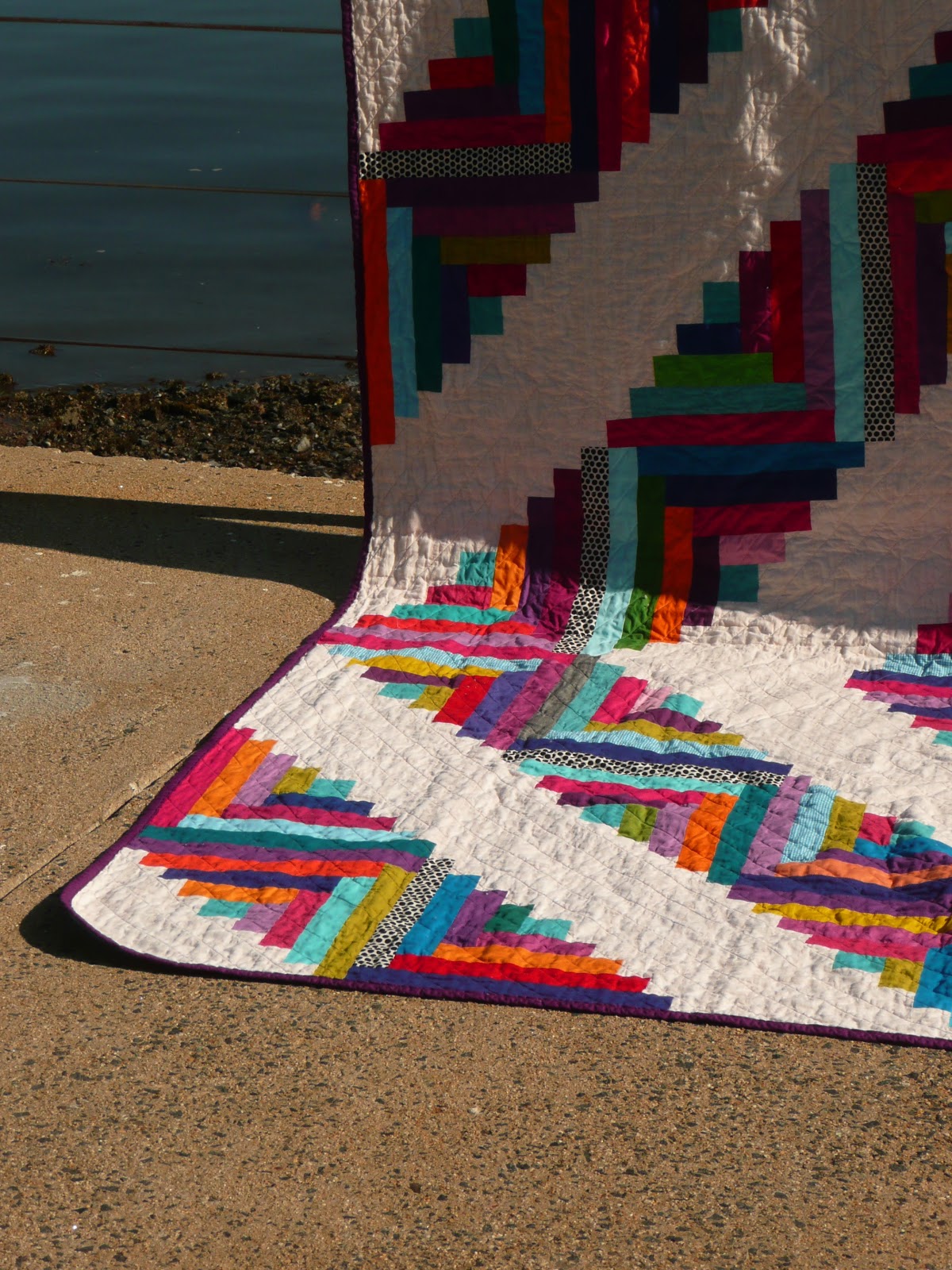
I started a light-and-dark log cabin in early May, following a huge fabric-buying spree at Keepsake and Marden's (a discount store in Sanford, Maine. Don't ask, just go.). I described the motivation and process for the quilt in this post, but it's been so long that I'll go over it again. I felt a sudden compulsion to attempt to use up my (albeit meager) scrap stash and make a Log Cabin quilt when I returned from the NEMQG retreat. I cut up all the scraps I had into 2" strips (for 1.5" finished "logs") and pulled out a stack of 2.5" squares that I already had sitting around from a failed project that I never posted about. (Don't you love when that happens?) I cut three yards of KF Shot Cotton in Blush into 2" strips, calculated some basic measurements, and went to town sewing a mockup block. Happy with the first attempt, I chain-pieced 48 more.


...not so fast, of course. There was a period during block construction where I just could not believe that the project would ever be finished. You know the stage: when you realize you're only about 60% of the way through the blocks and you find it all but impossible to imagine that your hours of slaving away at the machine have resulted in such a meager pile of fabric. "How many more seasons of Will & Grace must I endure before I finish this mother%^&$%?," you ask yourself as you try to remove the chocolate stain you left on the last block you ironed.

Anyway, the blocks took me more than a month to sew. Once I finished them, I realized that the blocks together measured nearly twice the size of my entire living room. I considered renting space in the library or resorting to other bizarre venues for laying out my blocks. Luckily, my friends Rachel and Piper very generously agreed to allow me to use their dining room, even going so far as to remove almost all of the furniture in the room to accommodate this behemoth.

I'm so glad I went to a friend's house at this stage because the diamond layout I had originally planned just wasn't working, and if I hadn't had another person there to corroborate my negative feelings about my chosen layout, I might have plowed ahead. But neither of us liked it, and finally I settled on a variation of the Barn Raising variation (haha): an off-center diamond.


I am just so happy with the layout we chose, the way the fabrics are working together...everything, really! It's all solids except for one old gingham shirt of Amy's (which you can't tell is a print unless you are six inches away from it) and a few strips of Yuwa Honeycomb in black. The top measures about 95" square.


Once I had the layout set, I sewed the top together within a couple of days. I also whipped up a backing using Kona Light Jade and as many scraps from the project as possible. I have to admit that I can't conjure up the love for pieced backs that most quilters seem to possess. I think I'm going to start using Fat Backs, even though the fabric selection leaves much to be desired. By the time I've finished a quilt top, I'm ready to quilt it, bind it, and enjoy it. Sewing a backing just frustrates me. I have "sew-cried" my way through many a pieced back. Now I just need to find an inexpensive source for Fat Backs...and, of course, quilt this monster!

I hope you all had a productive weekend!

Thursday, July 28, 2011

American Folk Art Museum, Part Two


Sorry for the radio silence over the past week...I've been taking advantage of a spate of cooler weather to quilt a gigantic quilt! So without much further ado, here is the second part of my writeup about my visit to the American Folk Art Museum (part one is here).

The best part of the exhibit by far was the selection of Log Cabin quilts. They didn't have many Log Cabins in the show, but the ones they did were just beautiful. All except for one were light-and-dark variations, and the remaining quilt was a lovely Courthouse Steps variation. I learned from their placard that traditional Log Cabin quilts were foundation-pieced, not batted, and not quilted (though they were sometimes tied). I was very surprised to learn that! I will definitely use that method for the next Log Cabin I make.

I started working on a Log Cabin about two months before I went to the show, and I thought I wanted to lay mine out in the variation above. The fabric contrasts in the quilt above and the one following were so stark that the quilts almost glowed.

In the quilt above, the blocks were smaller than usual--probably only 6" or 7". I had never seen such an unusual Log Cabin block arrangement before. You wouldn't just stumble upon this arrangement; it was clearly carefully planned out. The corner blocks have a pink center square, but are completely black, whereas the rest of the blocks have a black center square and contrasting black and pink "logs." There are also tiny squares of yellow integrated into the pink side of eight blocks. Finally, the pink sides of the blocks feature a maroon strip that lends a lattice-like appearance to the finished quilt.

This Courthouse Steps quilt was one of the best I've ever seen (and my favorite quilt in the show). Its maker was a retired tailor who gathered up his satin, silk, and velvet lining scraps for several years and finally made this quilt. I took at least ten pictures of it, but the lighting was very harsh and they didn't all come out. This one made me want to make a Courthouse Steps quilt ASAP. My last quilt generated enough scraps that I think I may be able to do a small one.


The museum also displayed a beautiful quilt in the Barn Raising variation (some people today call this variation a "Center Diamond" instead).

I loved the border that the maker added. It gives the quilt more movement and dimensionality, I think.


So there you have it! Although they only displayed four or five quilts, I loved them all and thought they were the best in the show. I had been working on my own Log Cabin quilt for about two months when I went to the show, which I think is why it struck a chord with me. I'll show photos of the layout process for my Log Cabin tomorrow. But now, I'm back to quilting. Enjoy the weather, everyone!


Thursday, July 21, 2011

Diary of a Vintage Raleigh Restoration: Part One


Last weekend, we journeyed to the famous Grafton Flea Market. I was really hoping to find some old bike parts or a basket; instead, we came home with a 1954 Raleigh Sports bicycle.

I spied the dilapidated bike from the corner of my eye while looking at some weird canoe furniture, and couldn't believe our luck. And by "our luck," I mean Amy's luck, because I am one of the unluckiest people you'll ever meet. My Irish luck is canceled out by French-Canadianness, perhaps. Anyway, what got me most excited was the rear rack and the light post (a piece that clamps below the handlebars for you to attach a light to). I needed a rack for my bike, and it is my understanding that only one type of rack fits these bikes: the Pletscher rack. I had purchased one new from Harris Cyclery, but much preferred the version with the rear reflector that originally came on some models of the Raleigh Sports.

The stall where we found the Raleigh featured many interesting odds and ends, as well as a large collection of leaf blowers. "How much?" I asked the skinny, balding dude lurking around the stall with the look of a used-stuff dealer about him. "Twenty bucks," he replied. Amy and I conferred between ourselves while wandering around another booth and buying tools (from a lady who claimed to be offering us a deal because she "liked seeing girls buy tools").

What I really wanted was the rear rack, and although we had talked about getting a vintage Raleigh to restore for Amy soon, this one seemed like it needed a bit too much work for us. We knew a bit about cosmetic restoration, but not enough about bicycle repair. I knew the bicycle had to be from the 50s or very early 60s, when Raleigh Sports featured the full chaincase. But five minutes later, we were back at the booth. The rack would pay for itself, and the rest of the project would be fun, right?


"How much for just the rear rack?" I asked.

"Twenty bucks for the rack, twenty bucks for the bike. Ya gotta take the whole thing. I gotta get rid of it," he responded. He then proceeded to inform us how valuable each part of the bike was. It did have a Brooks saddle in fairly good condition, as well as some other unique features. We didn't need him to sell us on it, though. We could have sold the saddle alone and made twice what we paid for the bike. And also, the dude knew nothing about bikes.


I tried to play it cool while we stood there having a whispered conversation about how we would get it home. We really wanted the bike, but we had driven there in a 1996 Geo Tracker, and they're really too small to accommodate two adults and a full-size bicycle. Finally we just said, "We can figure it out." We bought a 50-cent ball of twine at a neighboring stall, gave the man his $20, and "rolled" the bike away. The tires were so rotted that we more or less dragged it out of the market while people gaped at us. Whatever. I had brought exactly $20 to the flea market, so it was serendipitous, and we had a new project!


Now here comes the silly part: us strapping it into the car, trying to ignore the ogling of strangers and small children.


We had to pull off the front wheels to get the bike to fit, which was no easy task...this bike was made long before the days of easy-off front wheels. And we didn't even know how to get the top off of the car, so we had to spend some quality time with the instruction manual.


Eventually, we got it loaded securely into the car, picked up some Dunkin' iced coffee, sped down I-90...and made it safely home. And that's when the real fun began...


Monday, July 18, 2011

American Folk Art Museum, Part One

I'm having a health issue right now that requires me not to spend time in the heat and sun, and because I don't have AC in my apartment, that means no sewing! Last week I tried to sew, ended up heating my apartment to almost 95, and made my condition significantly worse. So this is the perfect time to post my photos from my trip to the American Folk Art Museum in NYC.


I had wanted to go to this show with my friend Yahaira, but Amy and I ended up needing to visit the city for something during the last few days of the show, so it was the perfect opportunity for me to see it (the show closed on July 8). I took a non-quilter friend, and yall know how that can be, but she was a good sport about the whole thing.


(Excuse the glare, through which you can see my legs and feet!)

Like all quilt shows I've attended, it was organized by type of quilt, which roughly corresponded to periods of years (though not always). They also displayed a few total outliers. I plan to write a separate post about the Log Cabin quilts, but here are some of my favorites from the other portions.

The museum grouped together the applique and signature quilts from its collection. It displayed one gorgeous Baltimore Album quilt, which was by far the best example of such quilts that I have ever seen in real life:


Here is my favorite block, which depicts the Capitol building:

What struck me most about this quilt was the very modern color combination. It reminded me of a few Moda fabric lines from the last year and a half or so.


A few other images from this portion are below. Many of the quilts featured writing or images drawn directly on the front of the quilt. In this particular star signature quilt, each block contained a very detailed image, like the bird below:


The messages drawn on the following quilt were faded from wear and difficult to discern. I wish I could have read them, but they probably were never intended for the prying eyes of the public anyway! I loved the following block in particular; most of the work you see is embroidery. I've noticed many more quilts with surface embroidery recently.


This whitework quilt was the best-preserved quilt I've ever seen at a quilt show. It dates to around 1800, if you can believe it. There wasn't a tear or stain in sight.


I particularly loved this quilt, which featured a stunning likeness of our 22nd and 24th President, Mr. Grover Cleveland:


Since President Cleveland was not married when he entered office, I like to think that some young woman was pining away for the strong and handsome Grover during the making of this quilt. I'm pretty sure it was the work of a quilt guild, though.


This Dresden Plate quilt represented the entire 30s. I appreciated the work that went into it, but I didn't feel very drawn to it, even though I love repros. I guess it didn't help that some irresponsible parents were allowing their three young children to grab at it and pull on it while I was trying to take photographs. (My friend, who has been a nanny in NYC for years, didn't help matters by muttering angrily about the childrens' poor behavior.)


The show also featured a section on African American quilts, with a lovely writeup about how few African American quilts have survived, out of an unknown number that were created. I left wondering how diverse the African American quilting tradition really was and is, and if what we think of as the style of African American quilting is even wholly accurate.


Of course, there were many other quilts at the show. I hope you got a chance to go to one of the two exhibitions the museum hosted. I thought they did a beautiful job. They chose wonderful examples from their collections, and I am so happy I had the opportunity to visit. But the best is yet to come. Stay tuned for the second part of my writeup!

Thursday, July 14, 2011

And Now for Something a Little Different...


As I prepared to move out to Michigan, I realized I would probably need a mode of transportation besides my feet, which have been perfectly sufficient for getting around Boston for the last four years. I would, at the very least, need something that would enable me to buy groceries at a store not within walking distance...and something that would help me haul home all of my goodies from the fantastic antique store down the street. So it came down to an electric scooter or a bicycle, and the bicycle won (for many reasons).

And that is how I stumbled into a very unlikely hobby: bicycle restoration.

I purchased this 1972 Lady's Raleigh Sports Limited III from Menotony Bicycles in Cambridge. After fooling around with Craigslist for ages looking for a vintage (50s-70s) Raleigh bicycle in good condition, I finally headed over to Menotony, and I bought one on the spot. I had many reasons for preferring a vintage to a modern bicycle. Today's bicycles are not the same quality and not made with the attention to detail I wanted at a price I could afford. Vintage bicycles are built to last: fully lugged, steel frames, and the works. You can learn more about that here and here (and if you are AT ALL interested in buying or restoring a vintage bicycle, this site is one of only two you will ever need).

The frame of my bicycle was in near-perfect condition. There were no dents or others issues in the fenders, and very little rust on the handlebars and seat post. I even had the original reflector on the back fender and the original sideview mirror!

But of course, I had a great deal of work to do. My bike needed a significant cleaning, as well as new brakes, new pedals, new grips, and a new saddle. The standard-issue grips, pedals, and saddles were unbearably uncomfortable. I slipped on the worn-down pedals and killed my palms the first time I took it for an hour-long ride, and the saddle left me sore for days.

The first and easiest-to-install purchase was the saddle. I ordered a new model of a Brooks saddle that existed in the 1930s, with adorable floral embossing all over the seat. This saddle was made for upright-style bikes such as mine:

Here it is fully installed on the bike:

I purchased MKS Sylvan Touring Pedals from Harris Cyclery, and I absolutely love them. They're grippy, economical, and they match the look of the bike perfectly.

I purchased standard-issue cork grips and then spent three days staining and lacquering them until they matched the color of the saddle as closely as possible:

My only concession to cosmetics alone was the tires. The black tires that Menotony Bicycles installed were perfectly sufficient, but I absolutely had to have cream tires. I paid dearly for my Delta Schwabe Cruisers, but I love them.

Phase 1 of the restoration (structural components) is complete. Phase 2 will involve the addition of accessories. I am trying to buy as many period-appropriate and vintage accessories as possible. For example, I hope to find the original rack that came on these bicycles.

Restoring my bicycle has been a tremendously rewarding and exciting project! My enthusiasm for this project inspired Amy, and we managed to find an even older version of this bike at the Grafton Flea Market last weekend. Her bike was in considerably worse condition than mine, and I'll be detailing the entire restoration process on this blog, including photos of us strapping it into her Geo Tracker and flying down I-90.

Have a great weekend, everyone! Oh, and my friend had her baby--a girl, which is great news for me since the quilt I made for her was decidedly NOT gender-neutral :)